
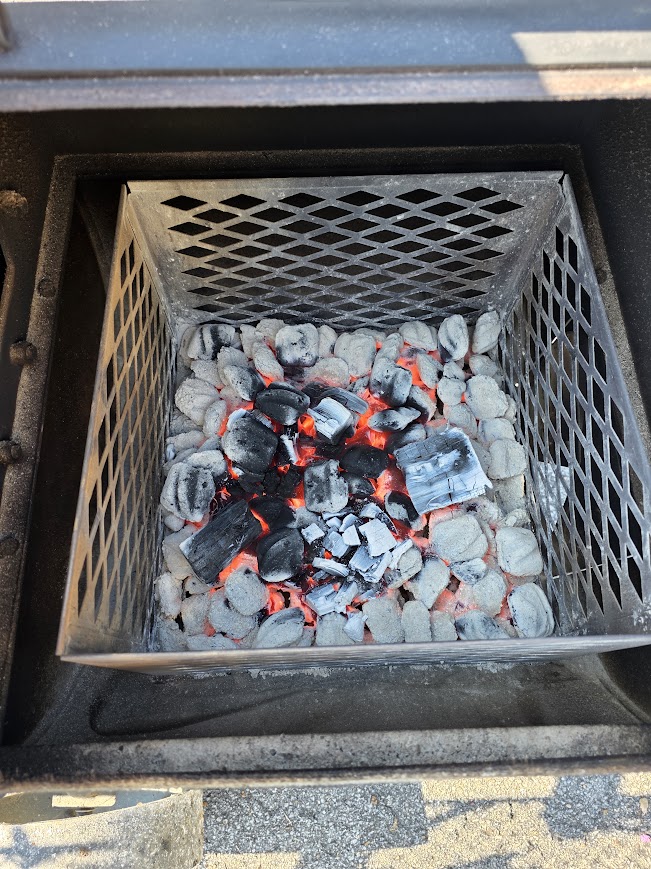
The first time my fire weakened after I closed the firebox on The Beast, I assumed the problem had to be airflow.
The side vent was already wide open, so I opened the firebox again and waited for the coals to come back.
They didn’t.
The fire was mostly charcoal with one wood chunk. The coals had weakened considerably, the wood started smoldering, and the fire never really recovered on its own.
What finally fixed it was lighting another batch of charcoal in my chimney starter and waiting until those coals were burning hot before pouring them into the firebox.
That experience taught me something important: if an offset-smoker fire dies after you close the firebox, the problem may not be the vent position. The coal bed itself may simply not be strong enough yet.
The Fire Looked Fine Until I Closed the Firebox

My fire that day was mostly charcoal with one chunk of wood added for smoke.
The intake vent on the side of the firebox was fully open, so I thought the fire had plenty of air.
But after I closed the firebox, the charcoal weakened significantly.
The wood chunk started smoldering instead of burning cleanly, and the fire lost enough energy that the smoker temperature started heading in the wrong direction.
If you’re trying to figure out whether a temperature drop is normal or a sign of a weakening fire, I break that down in my guide to why smoker temperatures fluctuate.
At first, I assumed opening the firebox would solve the problem.
It didn’t.
That was the clue that the issue was not simply a lack of immediate airflow. The coal bed itself was too weak to keep the fire moving once the firebox was closed.
Why Opening the Firebox Didn’t Fix It
Opening the firebox gave the fire more oxygen, but in this case, more air was not enough.
The charcoal was already too weak.
That matters because airflow can help a healthy fire burn harder, but it cannot magically create heat that is no longer there.
The coals had cooled enough that the wood chunk could not ignite cleanly. Instead, it sat there smoldering.
That is when I stopped trying to revive the old fire and decided to rebuild the coal bed.
How I Recovered the Fire

I lit more charcoal in a chimney starter.
The important part was not just adding more charcoal. It was waiting until that charcoal was burning hot before I poured it into the firebox.
That was the lesson I had missed earlier.
If the charcoal is not fully established before it goes into the smoker, you can end up with a weak fire that looks like it should work but does not have enough stored heat to support the wood or recover from a drop in temperature.
Once the fresh charcoal was burning well, I poured it into the firebox and gave the fire time to rebuild.
That finally brought the coal bed back to life.
That recovery reinforced why I now pay so much attention to the initial coal bed. I explain my normal startup process in how I build my fire on The Beast.
The Real Lesson Was the Coal Bed

The mistake was not closing the firebox.
The mistake was closing it before the charcoal bed was strong enough to keep burning cleanly without the extra air from the open door.
Now, when I start a cook, I make sure the charcoal in my chimney starter is fully hot before I dump it into the firebox.
I normally use Jealous Devil briquettes as the base fuel, and I explain why in my guide to the charcoal I use in my offset smoker.
I am not looking for charcoal that has just started to catch.
I want a properly established fire that has enough heat to survive the transition from an open firebox to a closed one.
That gives the wood a better chance to ignite instead of smoldering.
What I Watch Before Closing the Firebox
Before I close the firebox now, I pay attention to the condition of the charcoal rather than just assuming the fire is ready.
I want to see:
- charcoal that is clearly burning hot
- a strong coal bed rather than a few struggling coals
- enough heat to ignite the next piece of wood
- good airflow through the firebox
- smoke that is beginning to clean up rather than getting thicker
If the coals still look weak or dark, I give them more time.
That extra patience is easier than trying to rebuild a dying fire later.
What Smoldering Wood Tells Me
One of the biggest warning signs is wood that starts smoldering instead of catching.
A little smoke after adding wood is normal.
But if the wood keeps smoldering, the coal bed is weakening, and the smoker temperature is falling, I take that as a sign that the fire needs more help.
If the fire has already weakened to that point, I walk through the recovery process in how I recover a weak offset-smoker fire.
That does not always mean more airflow.
Sometimes it means the fire simply needs more heat.
That was the difference I had to learn.
Do I Leave the Firebox Open Now?
No.
I still close the firebox during normal cooking.
The lesson was not that The Beast needs the firebox left open all the time. The lesson was that the fire needs to be strong enough before I close it.
Once the coal bed is healthy, the intake vent can do its job and the fire can keep burning inside the closed firebox.
If the fire only stays alive while the door is open, I start looking at the strength of the coal bed before I blame the smoker.
That distinction saved me a lot of frustration.
Final Thoughts
If your offset-smoker fire weakens after you close the firebox, do not assume the solution is simply opening the vent farther.
In my case, the intake was already wide open.
The real problem was that the charcoal bed was not strong enough before I closed the firebox.
Opening the door did not bring the fire back. Lighting a fresh batch of charcoal, waiting until it was fully hot, and rebuilding the coal bed did.
Now I make sure the charcoal is properly established before I close the firebox and move into the next stage of the cook.
That one change has made The Beast much easier to manage.
Sometimes the problem is airflow.
Sometimes the problem is heat.
Learning the difference is part of learning the smoker.
Leave a Reply