
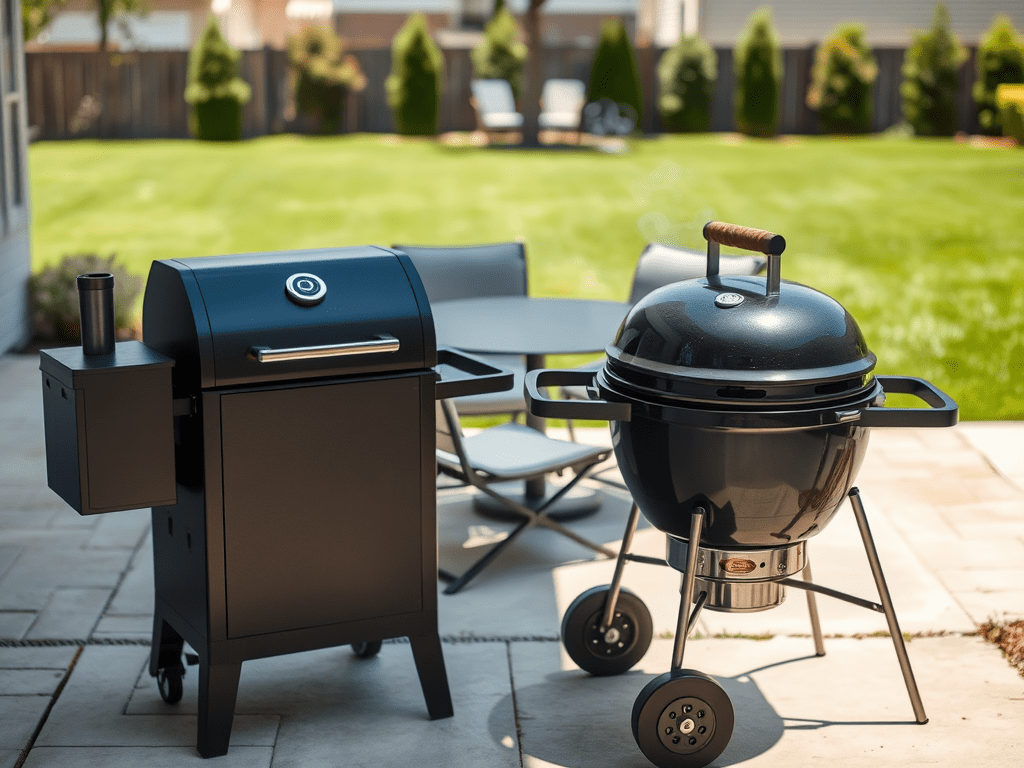
When people compare pellet smokers and charcoal smokers, they usually focus on flavor or convenience. But long-term cost is rarely discussed clearly.
The upfront price is only part of the equation. Fuel costs, replacement parts, and maintenance add up over time. If you’re trying to decide which smoker makes more financial sense, it helps to look beyond the sticker price.
Upfront Purchase Cost
Pellet smokers typically cost more upfront. Entry-level models often start higher than basic charcoal smokers, especially when you factor in digital controllers and electronic components.
Charcoal smokers, particularly kettle-style or barrel-style models, can be significantly less expensive to get started.
However, price ranges vary widely in both categories. A premium charcoal setup can cost as much as — or more than — a mid-range pellet smoker. The real difference shows up over time, not just on day one.
Fuel Costs Over Time
Fuel is where long-term costs begin to separate more clearly. Pellet smokers rely on compressed wood pellets, while charcoal smokers use lump charcoal or briquettes — often supplemented with wood chunks for smoke flavor.
Pellet consumption depends on temperature and weather, but steady low-and-slow cooks burn consistently for hours at a time. Charcoal usage varies more depending on fire management and airflow.
Over five years of regular cooking, fuel becomes a recurring expense. The difference may not be dramatic for occasional backyard cooks, but frequent smokers will notice it adding up.
Estimating 5-Year Fuel Costs
Let’s assume someone smokes twice a month — roughly 24 cooks per year. Over five years, that’s about 120 cooks.
Pellet smokers might use several pounds of pellets per cook depending on temperature and duration. Charcoal smokers may use a chimney or more per session, plus occasional wood chunks.
Depending on local pricing and cooking style, total five-year fuel costs can end up in a similar range — often a few hundred dollars apart rather than thousands.
For most backyard cooks, fuel cost differences matter less than consistency, convenience, and personal preference.
Maintenance and Replacement Parts
Long-term cost isn’t just about fuel. Maintenance and replacement parts can change the equation.
Pellet smokers contain electronic components — controllers, augers, fans, and igniters. Over several years, some of these parts may need replacement depending on usage and build quality.
Charcoal smokers are mechanically simpler. Aside from grates, gaskets, or occasional hardware replacements, there are fewer components that can fail.
That simplicity can mean lower long-term repair costs — but it also means less automation and temperature control.
So Which One Is More Affordable?
Over five years, the total cost difference between pellet and charcoal smokers is often smaller than people expect. Pellet smokers typically cost more upfront and may carry slightly higher long-term maintenance risk. Charcoal smokers cost less to start and are mechanically simpler.
But fuel costs over time are usually closer than the debate suggests. For many backyard cooks, the real decision comes down to convenience versus hands-on fire management — not dollars alone.
If you’re weighing more than just cost, it helps to look at flavor, ease of use, and overall cooking style as well.
 Smoke Tested BBQ